
Process
- Identify enclosure, driver, lighting, and reflection constraints.
- Generate one restrained reveal and retain the delivered file.
- Review geometry and decide whether it may enter client approval.
For Home-electronics teams and agencies reviewing product-ad motion: start with one synthetic transparent-speaker image and a product-preservation brief.
Acceptable result: a documented motion candidate with recorded geometry checks, delivery details, Credit estimate, failures, and production decision.
The page reports only the retained Credit estimate; the current campaign quote is authoritative.
This home-electronics case animates one transparent speaker with Hailuo 2.3 Fast. The output keeps the driver, enclosure, dark set, blue lighting, and single-device count while adding a restrained orbit and particles. It works as a campaign candidate, but transparent geometry, exact ports, dimensions, accessories, and acoustic claims still need product-record review.
Generation cases retain the input, settings, and historical cost; local audits retain the inspected file and every observed check.
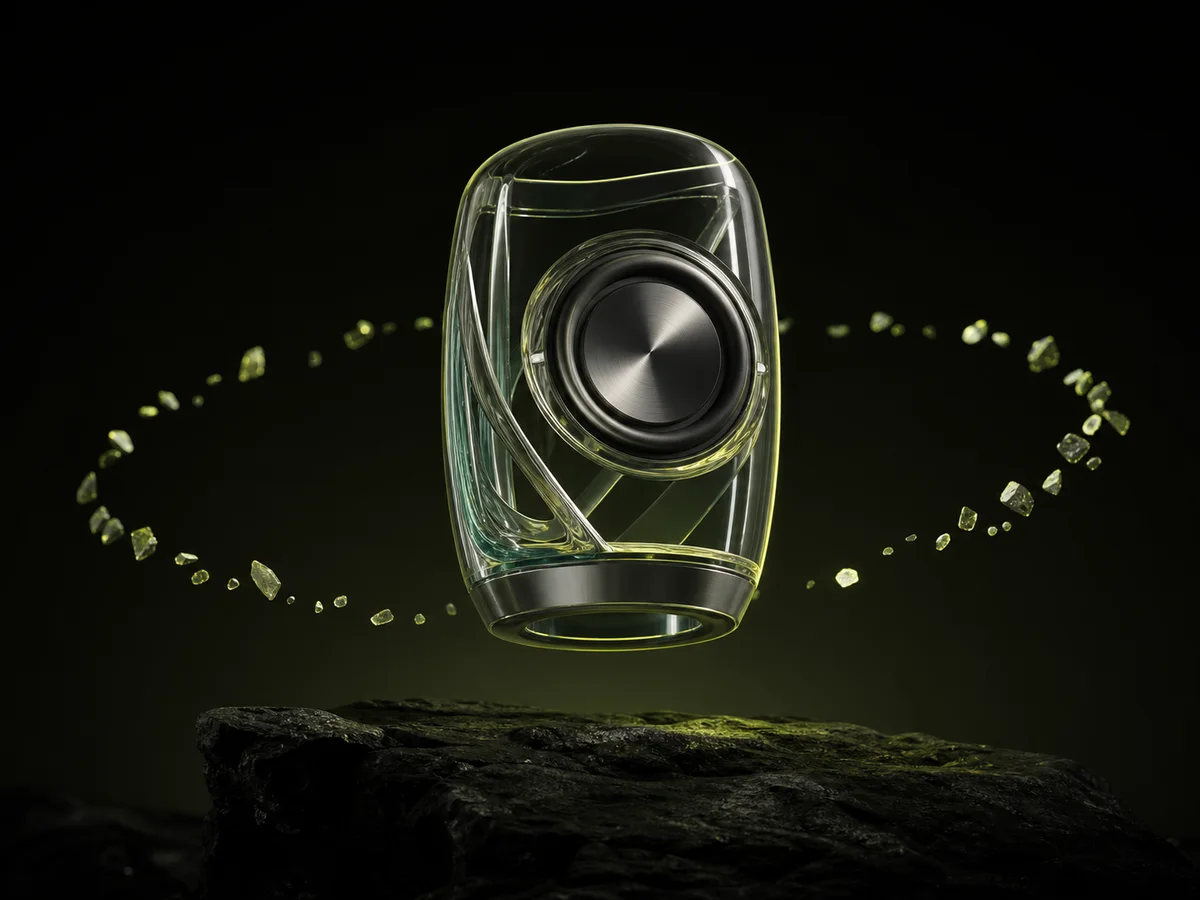 Input
Model: Hailuo 2.3 Fast via Replicate
The accepted sequence retains one transparent speaker, the circular driver, enclosure silhouette, dark set, and blue accent lighting. It adds no logo, caption, cable, hand, or extra device.
The changing camera angle makes exact transparent-surface geometry difficult to prove, and the editorial delivery is four seconds even though six seconds were requested.
Observed failures
The source shows one transparent speaker on a dark set with a visible circular driver, reflective enclosure, and blue accent light. The brief requested a precise consumer-electronics video: slow controlled orbit, subtle particle movement, crisp specular highlights, preservation of the speaker geometry, driver, transparent enclosure, materials, and dark setting, one continuous shot, no cuts, no text, and no invented logo. The creative goal was to make industrial design readable, not to demonstrate sound output, connectivity, waterproofing, included cables, room coverage, or any specification absent from the image.
Hailuo 2.3 Fast ran through Replicate. The editorial record requested six seconds, logged 63,593 milliseconds of provider-total generation time, and retained a four-second MP4 and WebM with a 960 × 720 final frame. The equivalent Studio estimate was 113 Credits; the owned editorial task charged zero user Credits. That distinction prevents a launch asset from being presented as a customer billing receipt. Future work must use the live quote. The shorter delivered file is retained as a visible provider-output mismatch rather than silently relabeled as the requested duration.
Human review accepted one device, the circular driver, the broad transparent enclosure silhouette, dark stage, and blue lighting through the orbit. No caption, brand mark, hand, cable, second speaker, or unrelated prop was introduced. The object stays central and the camera move provides enough change for a short product-design reveal. The result is suitable evidence for one controlled creative candidate. It does not certify that every edge, internal component, port, foot, material thickness, or reflection is dimensionally identical to a manufactured speaker, especially as the camera exposes previously hidden surfaces.
Transparency makes small geometry errors harder to detect because the background, highlights, and internal forms overlap. Reject a retry if the circular driver bends, the enclosure edge changes thickness, feet or ports move, an internal part appears or disappears, or the material becomes opaque. Decorative particles and reflections are not evidence of acoustic performance. A real product requires comparison with approved front, side, rear, and detail photography because one source image cannot define hidden geometry. If port layout or included accessories must be shown, use conventional footage or a verified 3D render instead of generative inference.
The clip fits a product-detail hero, industrial-design block, collection campaign, or a short social teaser when the device is sold primarily through its visual form. It is less suitable for instruction, setup, technical comparison, accessibility demonstration, or any claim about sound. The same approach can work for lamps, glassware, décor, compact appliances, and rigid home accessories when the source clearly shows critical features. Avoid it for articulated furniture, complex assembly, reflective controls, moving mechanisms, safety labels, or dimensions that the customer must rely on before purchase.
Use the accepted orbit as a secondary campaign asset beside factual product images, specifications, and verified dimensions. In Shopify, test the theme’s video component, poster, load behavior, and mobile crop. In a social ad, reserve text and interface space and attach only approved claims. Keep the source, output, prompt, model, duration mismatch, Credit estimate, review date, and rejection list in the delivery folder. For the next asset, generate one representative product before scaling the theme, and compare video routes when aspect control or camera restraint matters more than stylistic movement.
One source view cannot prove hidden geometry, ports, dimensions, accessories, material thickness, or performance. The delivered clip is also shorter than the recorded request.
Open the campaign plan or Studio, review the current quote, and use pricing only when the workflow fits.